 TankFeed
- Water
- Marine
- Animal group
- Sea anemone
- Attachment
- Foot anchored in reef crevices
- Tentacles
- Bulbed or elongated
- Nutrition
- Algal symbiosis and prey capture
- Ocellaris
- Possible aquarium partner
- Habitat
- Saltwater
- Type
- Anemones
- Level
- Advanced
Bubble-tip anemone care: placement, everyday observations and why an ocellaris clownfish may not accept it as a partner.
An animal with needs of its own
Would you like to watch your clownfish pair among anemone tentacles? Start with the anemone: would you still want to care for it if the fish ignored it? This article helps you prepare for that decision.
Entacmaea quadricolor is a cnidarian. Its foot anchors in reef crevices, with the tentacles extending above. Colours include red, green and brown. Tentacles may be bulbed or elongated, so a lack of bubbles alone does not establish illness.
Origin and habitat
The species has a broad Indo-Pacific distribution, from the Red Sea and East Africa to the western Pacific, and from Australia to Japan. Oregon Coast Aquarium describes coral reef habitat. A crevice anchors the foot; the visible tentacles are only part of the animal.
Will an ocellaris clownfish accept it?
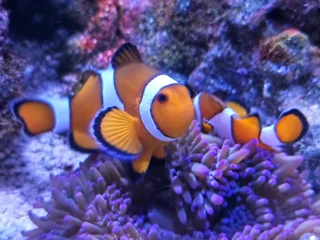
SDAT describes the bubble-tip anemone as a commonly used aquarium partner for clownfish. It is not, however, one of the documented natural hosts of Amphiprion ocellaris. Those are Heteractis magnifica, Stichodactyla gigantea and Stichodactyla mertensii.
Acceptance cannot be promised: a 2019 study observed it under certain experimental conditions, while a 2024 study found no symbiosis with this species in the ocellaris tested. Neither result guarantees success or rules out the combination entirely. Do not force contact between fish and anemone.
The linked clownfish article discusses care with or without an anemone and planning for a pair. Its tank-volume guidance does not replace planning for the anemone.
Placement, lighting and equipment
Lighting, suitable flow and stable water quality work together. Protect pump and filter intakes against wandering anemones; allow space around corals. Copper treatments do not belong in this aquarium.
Sketch the available space and neighbours the anemone could reach. Its position on purchase day should not determine the whole plan. Note your existing lighting and circulation for a discussion with the supplier.
Agree water conditions and acclimation
OATA gives general anemone guidance of 24–26 °C and pH 8.1–8.3. These are group guidelines, not a complete species specification. Agree the remaining target parameters and acclimation with the supplier before buying.
A volume or a particular tank age cannot answer every question. Ask how your full livestock plan and water records support the aquarium's suitability. Unresolved questions are a good reason to postpone a purchase.

Food, lighting and targeted feeding
Symbiotic algae live in the tissues and supply energy-rich compounds through photosynthesis. The anemone also captures animal prey using stinging cells. It is neither a plant nor simply a hiding place for fish.
Appropriately small pieces of shrimp are one animal-food option; Watson and colleagues studied direct shrimp feeding in Entacmaea quadricolor. OATA also lists mussel flesh for anemones. Match the piece to the animal: a large chunk is not automatically a better meal.
Gently offer a small prepared piece to the tentacles and let the anemone move it to its mouth. Do not push food into the mouth. Watch whether it keeps the food; remove rejected or expelled pieces. The linked article explains frozen-food preparation.
Adjust quantity and spacing to the animal's size, lighting, other food inputs and observed intake. OATA gives twice weekly as general guidance for many anemones, not a fixed species rule for every bubble-tip. The clownfish's twice-daily meals are not an anemone schedule. Record accepted foods and feeding responses; investigate repeated rejection before offering more.
Everyday observations
Compare position, expansion and tentacle shape over several days. Photographs under the same lighting and brief notes make changes easier to recognise. You can record the accompanying water parameters in TankFeed.
If tissue looks abnormal, the mouth remains open or colour fades markedly, check the water and seek experienced advice.
Bubble-tip anemones can reproduce by splitting. A division does not automatically establish that every aspect of their care is suitable. Ask about the origin and previous care of a divided animal offered for sale.
Your everyday aquarium care
Want to keep track of livestock and water readings? A free account lets you manage your own aquarium.