 TankFeed
- For
- Marine and reef aquariums
- Starting point
- Livestock and chosen care system
- Measurement
- Consistent method, clear unit
- Log
- Time, result and context
- Unexpected result
- Check plausibility, respond appropriately
- Examples
- Illustrations, not real aquarium data
- Habitat
- Saltwater
- Type
- Basics
- Level
- Easy
The test is finished. What does the number mean? A reliable routine helps you see what is changing in your aquarium and what needs a second measurement first.
Which water parameters should I test?
Your regular overview should include temperature, salinity, pH, KH or alkalinity, and nitrate. Reef aquariums also need particular attention to phosphate, calcium and magnesium. OATA distinguishes basic marine tests from additional reef tests accordingly. Which checks need to be frequent depends on livestock, demand and the care system.
Ammonium/ammonia and nitrite deserve particular attention during cycling, after stocking changes or when biological filtration may be impaired. Do not confuse a total ammonium/ammonia test with a direct measurement of toxic free ammonia, NH3. Interpretation of that fraction requires pH and temperature, among other factors; the test instructions define what its result means.
In aquarium terminology, KH tests measure alkalinity, the water's acid-neutralising capacity. KH is not another name for pH. An unexpected pH result is therefore not an automatic reason to add an alkalinity supplement.
Good values — for which aquarium?
Choose targets for all your livestock and the supplementation system you use. Chemist Randy Holmes-Farley suggests, for example, 35 ppt salinity and 7–11 dKH alkalinity as reference points for typical reef aquariums. These are not experimentally established tolerance limits for every species or an instruction to change a thriving aquarium in a day.
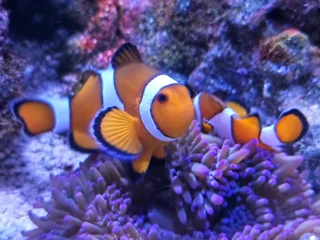
OATA gives 24–26 °C and a nitrate ceiling of 50 mg/l for clownfish as a group. A ceiling for this fish group is not a nitrate target for an aquarium with corals or anemones. The clownfish profile explains that context.
Decide which expert guidance you are following for your aquarium and record the livestock and care system. Combining a higher alkalinity range from a fish guide with very low nutrient targets from a specialised coral system does not itself create a coherent care plan.
How often should I test?
For clownfish care, OATA recommends weekly checks including pH, alkalinity and nitrogen compounds, and keeping records. This is useful guidance for a basic routine, not evidence that every parameter in every aquarium can go unchecked for seven days.
TankFeed suggests this adaptable starting plan: look at livestock, equipment and temperature daily; test the parameters relevant to your livestock once a week at a comparable time. In a stable reef aquarium, include salinity, alkalinity, nitrate and phosphate in that round; check calcium and magnesium according to demand and supplementation.
Shorten the interval for relevant parameters while establishing consumption, changing dosing, adding animals or investigating a deviation. Daily alkalinity tests may be needed when setting up supplementation. Consistent records will show whether longer intervals suit your aquarium.
Keep routine measurements at a comparable point relative to feeding, dosing and water changes. An additional test after an intervention is useful; label it clearly instead of treating it as an unchanged routine sample.
Make measurements comparable
Read the instructions for the specific test: suitability for seawater, measuring range, sample volume, sequence, mixing and reading time must all fit. With Tropic Marin's KH test, for example, changing sample volume changes the value of each drop. Remembered instructions for another product are not enough.
Prepare a clean work area and use the specified quantities. Fingerprints, dirt and bubbles can interfere with photometers; Hanna explicitly lists these in the HI774 manual. Follow the reaction time instead of leaving a prepared sample indefinitely before reading it.
Check reagent expiry and storage. A reference solution suitable for the parameter helps check test performance. A calcium/alkalinity mineral standard does not automatically check a phosphate test. Record a test or reagent change: a jump starting that day may be methodological.
Calibrate salinity instruments according to their own instructions and allow the instrument and sample to reach the required temperature. A refractometer needs an appropriate seawater scale; automatic temperature compensation does not replace correct handling.
Salinity, density, phosphorus: record the unit
Salinity, density and specific gravity describe related but different quantities. Record your instrument's scale: for example ppt for salinity, g/ml for density, or S.G. for dimensionless specific gravity. A reading of 1.026 S.G. must not be entered as 1.026 ppt. Conversions need a suitable table or instrument instructions, including the temperature reference.
Phosphorus and phosphate must not be copied as the same number either. For the Hanna HI736, the manufacturer gives: ppb phosphorus × 3.066 / 1000 = ppm phosphate. A calculation example: 10 ppb P corresponds to approximately 0.031 ppm PO4. An instrument already reporting ppm PO4 does not need this conversion.
This conversion describes the output of that orthophosphate test. It does not turn a laboratory total-phosphorus result into an identical measurement of dissolved orthophosphate. Keep the original measured quantity, unit and method alongside your result.
Is 0.04 really different from 0.05?
The last displayed digit does not automatically represent a reliable change. Hanna specifies 0.01 ppm resolution for the HI774, but accuracy of ±0.02 ppm plus ±5% of the reading at 25 °C. These are different specifications.
Applying that specification to a displayed 0.04 ppm gives a calculated deviation of ±0.022 ppm under the stated conditions. This is an explanatory calculation, not a statistical confidence interval. A move from 0.04 to 0.05 ppm alone therefore does not establish a real increase.
Check your own test's resolution, accuracy and suitable range. Undetectable does not mean that the substance is certainly absent. Preserve that qualification; an untested parameter stays blank rather than becoming zero.
What belongs in a water-test log?
A useful record answers five questions: When was the sample taken? Which parameter was tested? What was the result and unit? Which test was used? What had changed in the aquarium beforehand?
Record water changes, altered dosing, food amounts, new animals and equipment issues with their time. A short specific note such as “before water change, new reagent bottle” is more useful later than “bad water”. Keep observations separate from guesses.
Paper or a spreadsheet can do this. In TankFeed, you can save readings with a time and note for your aquarium and view their history. Check the offered unit before entering a value. Reading and learning do not require an account; saving your aquarium does.
Worked example: understanding falling alkalinity
Synthetic example, not a series from a real aquarium: Monday 6 pm, 8.0 dKH; Wednesday 6 pm, 7.6 dKH; Friday 6 pm, 7.2 dKH. Assume the same method with sufficient resolution was used, the results were checked, and no water change or dosing occurred between them.
Over four days, the observed net decrease is 0.8 dKH, averaging 0.2 dKH per day. This initially describes only the balance for that period. It does not establish coral consumption as the sole cause or prove that tomorrow's decrease will be the same.
Check salinity, test performance, possible precipitation and recent operation too. Any required supplementation must then be planned using actual water volume and the concentration of the specific product. Without those details, “0.2 dKH per day” does not yield a dose in millilitres.
If a water change had occurred on Thursday, the calculation would not represent undisturbed consumption. Keep the reading and add the event. A fresh consumption estimate needs a suitable comparison period.
What should I do with an unexpected result?
Look at the animals and equipment first. Unusual breathing, major changes in an animal or failed circulation should not wait for the next routine appointment. Check water quality and operation promptly, and seek knowledgeable help for affected animals.
For a surprising number without an acute problem, first check transcription, unit, sample volume, reagents and reading time. Repeat the test with a fresh sample. If the discrepancy persists, a suitable reference and, where needed, an independent cross-check can help.
Interpret the confirmed result alongside earlier readings and recorded interventions. Plan a targeted adjustment and follow-up check. Changing several additives at once makes the effects harder to understand later; a single outlier is not an automatic dosing instruction.
Connect the numbers to the animal
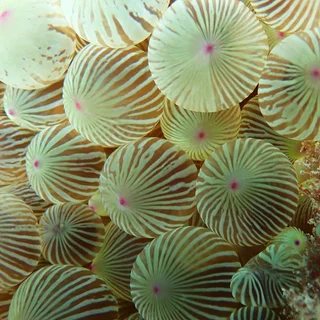
A numerical record complements animal observation. For a bubble-tip anemone, assessment also includes light, flow, location and food intake. Suitable water parameters do not explain every change; its profile helps you consider the wider picture.
The linked clownfish and bubble-tip anemone profiles describe their respective care requirements. Use them when setting your testing routine and before adding livestock.
Record feeding as context
If you change food type or portions, note this alongside the readings. Watch what the animals actually eat and what remains. A nutrient change at the same time is a reason to investigate, not proof of a single cause.
The frozen-food guide explains selection, portioning and leftovers. Appropriate feeding starts with the animals; a water parameter alone is not a complete feeding plan.

Your everyday aquarium care
Want to keep track of livestock and water readings? A free account lets you manage your own aquarium.